Sea Shrine

I made this puppet almost twenty years ago. She was too heavy to use in a show and after some time became my muse for the hispering, then moved to my ancestral altar where she’s been sitting amongst family photos, an urchin, other sea finds and some ribbon for the past few years. 

When I was asked if I would contribute to the Aqueous Futures exhibition in the Midland Hotel Morecambe it seemed this was her time to shine. I was asked because of my artistbooks, but I’ve been wanting to stretch beyond books for a while, even beyond how artistbooks stretch the book form.

She rises from the top compartment of an old oak bureau made by my gandfather which I’ve carted from house to house not really liking for years, but kept because he gave it to me and some other less articulated reason. The cabinet was used in an outdoor exhibition last August  near Plover Scar light, and shared my love for the area with anyone interested, and asked for more info on theirs in return.

The Sea Shrine is a scaled down / shrined up / simplified / less linguistical version of that iteration. She takes centre stage amongst waxed thread and eroded limpet shells. She crowns a mountain of periwinkle shells gathered from the bay. She aims to capture the collaborative sense that is ocean, the weedy, frondy, easily overlooked, less than explicit, absolutely hereness of the body of water that covers two thirds of our plants, just as the flow of waater occupies two thirds of our body. 

I wanted to make something that invited others to contribute to the making. I wanted there to be space for others to consider what the sea means to them. If we are to think of aqueous futures, how might we think beyond the disastrous? It’s too easy to swing to doom scenarios rather than sitting in the uncertainty of what is to come. What we know is where we are, now. The future is seeded in our present actions – actions being our speech, thoughts and behaviours. Our intentions, our aspirations are the scaffold for those actions. We all have the agency to shape the futre, our future, a future. And perhap no being more so than the ocean, upon whom all life depends.

I’m increasingly interested in the value of collective wisdom and in making pieces that rise from that collaboration which crosses time and space. After all, we are here as a result of that collectivity. 

And because I’m also becoming more interested in silence as much as words I wanted there to be an option to share a silent wish, not to put pressure on people to artciulare their feelings. When our hopes, aspirations, emotions and sensations are at their most raw they are pre-verbal. It could be said that in articulating them they lose power. When the finger points to the moon, we can become distracted by the finger rather than see the moon

This particular incarnation of the spirit of the ocean explains the value of the sea in text that runs up and down her legs. This text was printed at the new Morecambe Riso Press during an exploratory workshop that was my first time with the machine. I’ll be back. This scan of the pink does not do its glorious brightness justice.

The invitation to make silent wishes on the hag shells or word wishes on paper can be for her or for us. There is, ultimately, no difference. What we wish for ourselves is what we wish for the world.

She was in the exhibition space, as the tide came in and out over three unseasonably hot days and accrued some touching wishes. With windows either side of her I’m hoping the sense of the sea was evident for those who did make wishes, or just spent some time with her. 

and plenty of wishes that are not so pinned down

I hope she’ll continue to gather wishes we have for the ocean and all the beings who live in and from her. And welcome invitations from other venues who’d like to host her. 

Meanwhile, if you’d like to email a wish, then you can here: seashrine.ofthebay [at] gmail.com and I’ll make sure it catches the air and send you a picture of it in place.

If you’re curious, her measurements are: width: 530mm; depth, closed: 160mm;  open: 520 mm; height, full: 1230mm;  to the desk: 720mm. 

Hear Us O

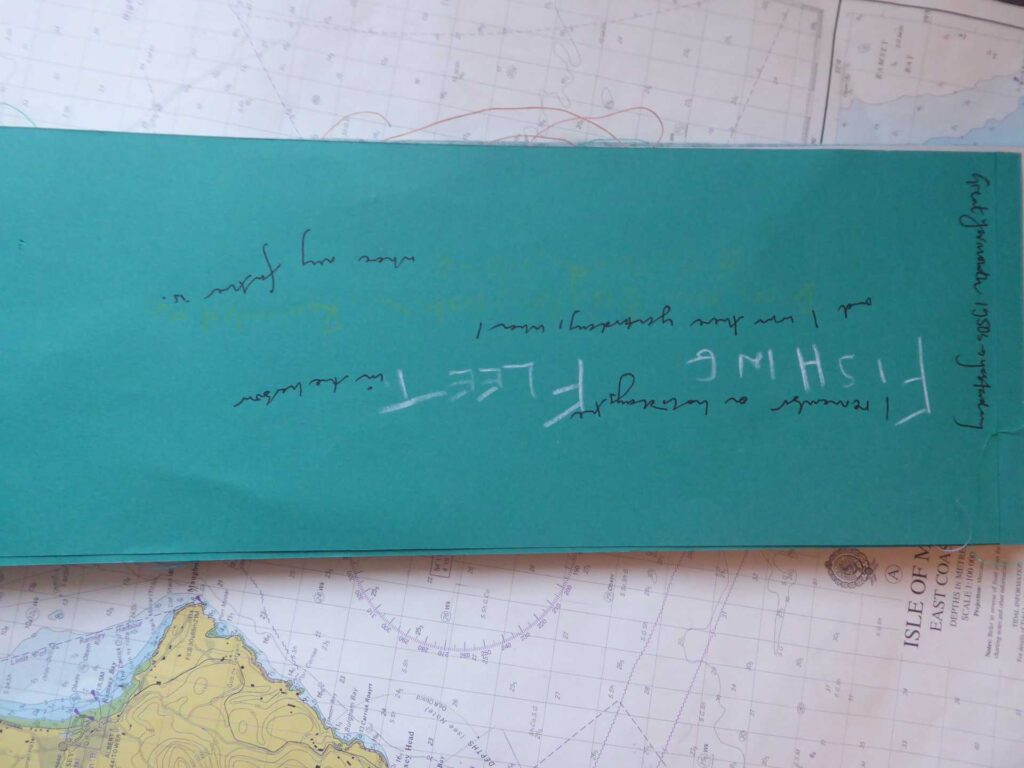
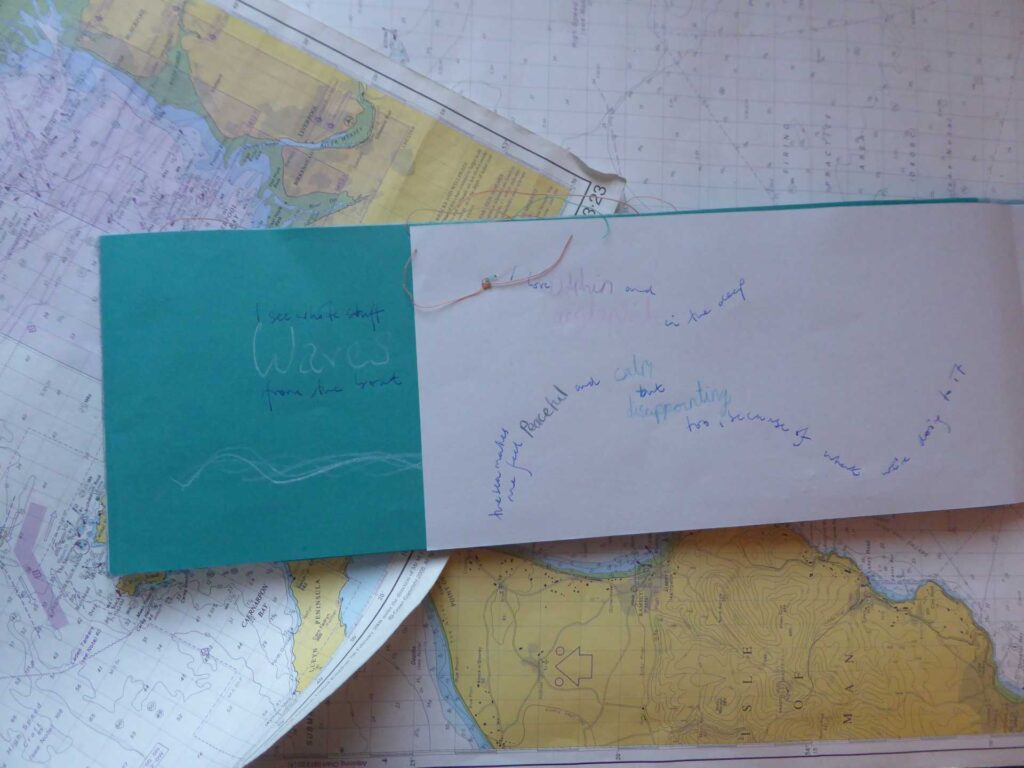
This is an incomplete book of the sea. Felted and decorated with tinnie yolks, which I’ve had in my plastic collection for a long long time, and fastened with the plastic shaft of a cotton bud, which used to be the most commonly found marine plastic on local shores before they were replaced with paper shafts in 2019. I’m taking it with me on the ferry from Liverpool to Douglas to invite other passengers to fill it. It’s part of the AHRC funded project alinging the work of Malcolm Lowry with contemporary concerns for the ocean, Hear Us O Lord From Heaven Thy Dwelling Place, with Leeds Beckett and Liverpool John Moore’s Universities.

At the moment it is full of blank interleaved pages that will, hopefully, by the time we reach Douglas, thoughts, feelings and memories of the sea from other passengers. Having made the book I was suddenly reminded of those autograph books we used to take to our last day of school to be filled with verses and signatures by people, which I loved: both writing in other people’s and collecting new verses.

I’ve got inks and brushes and stamps and pens and letraset for people to use to make marks, splodge and spill and write and draw their feelings and experiences and hopes and fears for the ocean. We’ll see what gets used, what gets written and how.

Having made the book I was reminded of those autograph books we used to take to our last day of school to be filled with verses and signatures by people, which I loved: both writing in other people’s and collecting new verses. This book might become an autograph book for the sea, I thought, filled with people’s wishes and blessings for it. As soon as we’d left the Mersey channel and turned into the Irish Sea, I tucked it under my arm, stashed a pencil case in my coat pocket and headed out on deck to find people with the time to spare to chat.

People were surprisingly receptive when I bounded up to them and asked if I could talk to them. Yes, they always said, with wariness to enthusiasm.

About the sea, I’d say. I’m making a book of the sea. And given the sea has so many creatures in it I want to populate the book with as many people as possible. At which point I’d wave the book, open it and let the pages spill out between the covers.

Whoever I’d approached would generally try to gather up the pages while I asked what memories or feelings or thoughts they had about the sea. It didn’t take long for them to open up: stories of holidays, relaxation, family members, of refugees, things found, things lost, strange sea creatures, the plastic and damage we’re doing to it. Everyone had something to say about the sea.

One group I approached I told there were as many organisms in a bucket of sea water as stars in the milky way. ‘I doubt that,’ one of them said. ‘I’m a physicist and there are trillions of stars in the milky way.’ ‘Consider the viruses and bacteria as well as all the plankton, I suggested. ‘And phages,’ he says. ‘Yes,’ I agree, ‘the phages.’ Before asking what they are. The most common biological entities in nature, he tells me. And writes the word greens into the book. I wished he’d written ‘phages’. He explained he chose ‘greens’ because of all the variations in the sea. His friend, who’d been listening, then told me how when he lived in Brighton he’d swim home from work every Wednesday whatever the weather, his suit bobbing in his dry bag behind him. And then kindly wrote the entire story out into the book.

Many people were happier talking than writing, so I decided it was perhaps easier if they wrote one word down and then told me why they’d chosen it and I’d write that around the word. My process changed over the three hours of the voyage, how approached people, how I cajoled them into writing in the book, how I wrote in it. And this feels central to the intervention – adaptation to environment, to others in the environment, to hold onto the aspiration for the book, but to be loose enough with it, to want to be as inclusive as possible and respond to who I spoke to rather than impose my method onto them.

Nobody abused their power of holding pen to paper. Nobody told me to f*** off. Everybody had something to say about the water through which we were crossing. And once they started they generally were away for minutes.

I enjoyed all the takes on our ocean. How precious it is, how dangerous, threatening, and under threat. The children amazed me with their knowledge of the creatures. Their joy in the diversity of the marine ecosystem I found poignant and hopeful. Someone insisted the ocean would be fine, and doesn’t actually need saving. It’s us we’re doing the damage to – our way of life. It’s us that needs saving. The ocean, however it evolves, will be ocean.

What is ocean if not transitory, fickle, connecting? The most visible element of our hydrological cycle, its water wheels around our world as cloud, rain, river, mud, ice, snow, sap, sweat, tears and on, changing its composition, bringing people from one shore to another, as we were being taken from Liverpool to Douglas.

The pages began to fill up over the crossing. And I wondered how much we also need to learn this ability to change from the ocean. If what we love we love because of it reflecting something of us, I wonder if we might learn to love our own mutability, develop our capacity to adapt, trickle through the nooks and crannies of a sea wall. Can the scrawls, crossings out, mixed up handwritings and splurges also be seen as precious, threatening or under threat as the ocean the pages seek to capture?

I didn’t have conversations about Malcolm Lowry or his stories with the people I met. Instead I felt I was following his voyages more obliquely, with my fellow crew adding marginalia to the pages of the book, all underlining Lowry’s conviction that close contact with the natural world provides nourishment, connection and enrichment.

The book still has space for more. I like the idea of these spaces remaining, of the sense of the sea remaining incomplete, not overstuff with plastic or deadzones or trawlers or windfarms. We need an ocean that hasn’t been totally scribbled all over by humans. An ocean we can’t completely read, make use of, perceive as a resource rather than a living being that houses trillions of other living beings.

In December 2023, Leeds Beckett University hosted an exhibition of the works arising from this project

image taken by Alan Dunn

a Hypercube for the Conder

a commissioned artistbook for the Entangled Festival, Morecambe, run by Ensemble, Lancaster University

The term ‘hypercube’ was coined by a team of scientists from Lancaster University and consultants from JBA, Skipton, as a web-based model for blending various data streams in flood risk management. This flexigon is an artistic response to their work. Living near the mouth of the Conder river, I witnessed its 2015 and 2017 flooding and wanted to focus on it for this commission.

I wanted to approach this project with as much sensitivity as possible, given I am dealing with a real life situation rather just theoretical modelling

This hypercube blends data from
https://nrfa.ceh.ac.uk/data/station/info/72014
http://es-websupp.lancs.ac.uk/hazelrigg/
https://flood-warning-information.service.gov.uk/warnings
https://twitter.com/ #galgate #flooding #22-23November2017
and info from
https://www.sciencedirect.com/science/article/pii/S2667010021000433
https://www.ensembleprojects.org/promoting-a-more-data-driven-approach-to-flood-risk-management-in-the-age-of-big-data/
https://luneriverstrust.org.uk/

It is made on 120gsm Accent Antique paper from GFSmith, acid free, FSC certified.

Other forms of data this paper hypercube doesn’t have the space for, that its digital counterpart will, are soil moisture and building impact. And therein lies conflict. This has been commissioned by Lancaster University I am aware of the potential pressures developments at Bailrigg and other new building projects near Ou and Burrow Becks as well as the Conder will exert on those rivers and existing communities, as well as the importance of natural flood management in the upper catchment area.

On the morning I went flysampling with Allen Norris, at the Forrest Hills sampling site (Monday 15th August 2021), he took in vivo samples of 163 beatis nymphs (agile darter upwing flies), 1 blue winged olive, 2 heptagenid (flat stone clingers) almost too small to see without a lens, 1 cased caddis, 21 caseless caddis, 7 stoneflies and 13 gammarus. This sample of the insects in this pool of the Conder represents 7 of the 8 taxons which, according to Allen, means pretty clean and biodiverse water.

These creatures have been living on the riverways for millennia, since before the dinosaurs. Let’s hope they continue to have a rich and fruitful life to enable the rest of the planet to be as rich and diverse.

Thanks are due to
Nick Chappell; Claire Dean; Mandy Dike; Liz Edwards; Sarah James; Rob Lamb; Allen Norris; Vatsala Nundloll; Ben Rigby; Will Simm; Floris Tomasini

We commissioned Sarah to create an artistic response to flood modelling research for the Entangled Festival in Summer ‘22. She worked with scientists and project partners to respond to complex research and lived experiences of flooding. Sarah was a delight to work with as an artist. Her curiosity and commitment are infectious. She was communicative throughout the commission process and met every deadline, meaning we could just relax and trust that she would deliver an inspiring creative response. Sarah’s artistbook surpassed our expectations. She brought content and form together in an engaging, multi-layered way, to produce a work that appeals to a range of audiences and can be returned to again and again – each time revealing something new.

Claire Dean for the Ensemble Network

One Day Plus

Here you’ll find all the offline provocations for our One Day Plus Imaginarium.

The recordings are designed for you to write alongside them, with recorded silence in which to write. You can, of course, switch off the audio at any time, and set your own alarm, repeat a provocation that works better than another, or make notes towards a thing rather than write the thing itself.

Each provocation is timed to give you space to faddle before and after it. If you need an early lunch then obviously slot it in to suit you. The sequence intends to grow and widen your thinking/dreaming.

1200-1230 Provocation One
A New Music: hearing the music or rhythm in your project.

This provocation works out of the thought that each new piece of writing has a particular voice, or music, that will lead you though the making of it. You’ll need: a piece of writing from earlier, an influencer book, and sheets of blank A4. When you’re ready, press play.


1330-1400 Provocation Two
Its Creatureliness: How does it feel?

This exercise approaches your idea / project / writing from a different angle: as another being, an embodied feeling thing. It asks you to identify moments that illuminate the larger feeling of the body of the project, and consider its shape or form through any changes that occur. You’ll need: whatever you use to write


1430-1500 Provocation Three
The terrain: What is contained within your piece?

Press play and gather around you what you’ll need: all the bits and pieces of your project: the previous writings, photos, influencer books, the music – all the things that have brought you to this point, this piece / project – and spread them on the floor or table top.


1500-1530 Provocation Four
A Tethering: The final writing session for now, discovering where your imagining, exploring and poking have brought you. Fifteen minutes to flesh out an aspect of the project. Write slowly, write carefully, write for the full fifteen minutes if you can.