End of Life Doula

Living in our world of multiple crises and witnessing the end of life of a dear friend who lived with Parkinsons for twenty years, the time felt right to offer myself to those who are living with anticipatory  grief or approaching their own end of life. 

In 2025, I undertook the foundation course to begin the process of becoming an End of Life Doula , with Living Well Dying Well. This means I am currently a registered End of Life Companion.

As an end of life doula, I provide emotional, practical, and spiritual support to people who are approaching the end of life, either through terminal illness or age, and those important to them. My role as Doula is one of compassion, advocacy, and companionship, ensuring that people feel heard, respected, and supported.

Please get in touch with me – sehymas [at] gmail [dot] com – or through https://eol-doula.uk/  to discuss your situation and needs.

My fees, as with my coaching practice, are responsive depending on your circumstances,. They range from £30-£70 per hour. By you paying the higher end of the range I’m able to continue to offer subsidised rates. Pay it forward, if you can.

I also charge the standard .45ppm for travel. I’m based in south Cumbria, equidistant between Kendal and Lancaster and can travel into North Yorkshire from here too.

Work in Progress

Dismantling My Mother’s House is part memoir, part autofiction. It has been shortlisted for Jericho Wirter’s First500 and highly commended in the Bridport Memoir Prize (reaching the last 6%)

What follows in the first few pages of the as yet unpublished manuscript

Dismantling My Mother’s House

Mummy, goodbye, sharp, singular, definite, wakes me to the dark of an unfamiliar bedroom early one October morning. Mummy, goodbye. They sound only the once but breach me awake. I know the voice. Recognise it, despite not having heard it for decades. It’s the voice of my child-self ringing out. Even though I’ve no recordings of myself as a young girl, I know the voice with the conviction of a mother. It was my child-self calling, delicate, then silent. I sit up in bed reaching for the voice echoing inside my head.

Mummy goodbye fading into the dark.

There’s only me in my brother’s spare room, on the top floor of his house. The dark expands the depth of the silence. How had the voice come? I hadn’t spoken. I felt no resonance in my throat from calling myself awake. And it hadn’t been deep enough to be the voice of my adult-self. A child’s voice, for sure. Nor had I dreamt it. The voice was too external. Disembodied and real, how the first telephone conversations must have sounded to their listeners.

A knock at the door dislodges my thinking. A crack of light, followed by my brother, dispels it completely. He has news. The hospital’s phoned, Mum has died. He sits on the edge of the bed and explains whose phone was off and whose on and who phoned him and who else knows. He breathes in the space, my silence. I thank him. We agree to talk more in the morning and he leaves. I’m listening for the voice again. Perhaps there’s more to be heard. But there’s nothing in the room except me rustling the duvet and the sound of my teenage niece sobbing next door. In a minute, I’ll go to her.

I don’t know what happened. Perhaps I’d tapped into some splintering of time, or self. Or made a prophecy. Perhaps I’d experienced an extraordinary regression. Intuitively sensing exactly when Mum died, or when the hospital phoned my other brother. Had this crossed in the night, to be intersected by some other transmission, deep within my unconscious?

Then relief dispels the questions. Mum will no longer be in pain.


Three small rocks rise from the glossy white sea of Mum’s kitchen window sill. Each is populated by miniature creatures, humans and trees made from shells, beads, pipe-cleaners, string and glue. I made these palm-sized islands before starting school, before either me or Mum knew I needed glasses, back in the Seventies, when shell art was a popular activity. I may not have heard my child-voice in decades, but I’ve long lived among the outflows of her imagination. So many things I made at school and home – embroidered mats, felt-tipped bookmarks, Valentine day cards – that Mum kept until they fell apart. And on this first visit to Mum’s house since her death, the first since that nocturnal calling out, these usually overlooked creations demand my attention.

I spent hours constructing and inhabiting these anchorages while the larger world pulsed beyond my immediate concerns. I would choose and arrange the shells of absent animals to be the bodies of new beady-eyed creatures with string tails or wool hair or lacy hats. Here I was queen, bestowing life and safety to whoever took shape from the fiddlings of my nail-bitten fingers. And the time spent in intense construction didn’t require my leaving Mum’s orbit as she baked, sewed or tidied.

Over the fifty years of their existence, the softening of glue, slipping heads from torsos, and detaching of beady eyes has obscured the original anatomies, warping them into surreal creatures, grubbied by thickening dust. Still Mum had brought them with her from our family home to this, her new one, arranging them on the pristine sill, keeping them precious, safe.


The miniature rock islands bind this home to the one where I grew up. Photos of us as a young family also add anchors of familiarity to a house that definitely isn’t my home. The furniture I loved as a child gives this small modern mews the air of an old lady’s home. Here, her dark oak corner cupboards, card tables and foot-rests oppress the smaller, modern armchairs and a dining set bought to fit. The weight and soft clicks of the cupboard doors and heavy drawers I’ve opened and closed my entire life still reassure me, but the velvet upholstery and ornate legs impose an era of stiff backs and waxed etiquette on the compact rooms. Adding to this mash up are traces of the previous owner, whose smoking habit, despite fresh paint and new carpets, was never totally eradicated during the six years Mum lived here. And without the heating and Mum’s cooking, the tobacco tang is creeping back throughout the ground floor.

Mum came here from the home I grew up in, where she’d lived for almost fifty years. Buying it from his parents, she and Dad moved in just before I was born. She’d spent the last years of the swinging sixties, such as they were in Yorkshire, rearranging rooms, replacing windows and painting walls to make the house her own, fit for her family. That house, like this new one, had a solidity typical of many houses in Harrogate. The spa town still is an anomaly of sorts in Yorkshire, although its gentility has been more closely matched by the gentrification in the nearby cities of Leeds and York. For my first eighteen years I’d loved living in that home, steeped in my father’s family history. It was as much inside me as I’d lived within it. An enclave, constructed by her, scuffed and taken for granted by the rest of us, as we ranged within and beyond it, always knowing it as a place to return to.

Even so, that home was less intimate than the very first one she’d provided me. In utero we were fused in a slow collaboration of bodies. There, one cell grew from another, multiplying into folds of flesh, in a network of needs, functions and sensibilities that fastened us together over the nine months of which I’ve no sure recollection.

I’d always done the leaving. Mum was always there when I returned. But now, all these sensations of home, holding me within their invisible scaffolds, pitch more air than architecture. The solidity I’d taken for granted, that I’d assumed was of my own making, now feels as empty as this house that needs to be cleared. And my body, untethered, unfocused, doesn’t know where or how to put itself.


It’s four years since I felt similarly bewildered.

Mum was still planning to live until she was a hundred when I went to the Arctic. I’d gone to Svalbard, with thirty other artists, for a residency aboard a repurposed brigantine. It was June and the sun did not set, merely rearranged the shadows of mountains, glaciers and moraines. What looked a few hundred metres away often turned out to be ten kilometres, or further. Million year old air hissed and popped from the bitty bergs we passed. I breathed in the exhalations of lives long gone. A glacier formed over four thousand years took five minutes to calve its front wall.

In the face of all this I shrank. And in the process of shying away from what I saw, I opened up. And not just me. Everyone on the boat was gawping and cooing, an assortment of infants scrabbling before the deliberations of rock, ice, mud and water reshaping before us. Every moment was an event, a first, that bore witness to the actions of the industrialised world. Every moment was an act of recalibration. We were face to face with the consequences of two hundred plus years of not looking. And now I didn’t know where to settle my gaze.

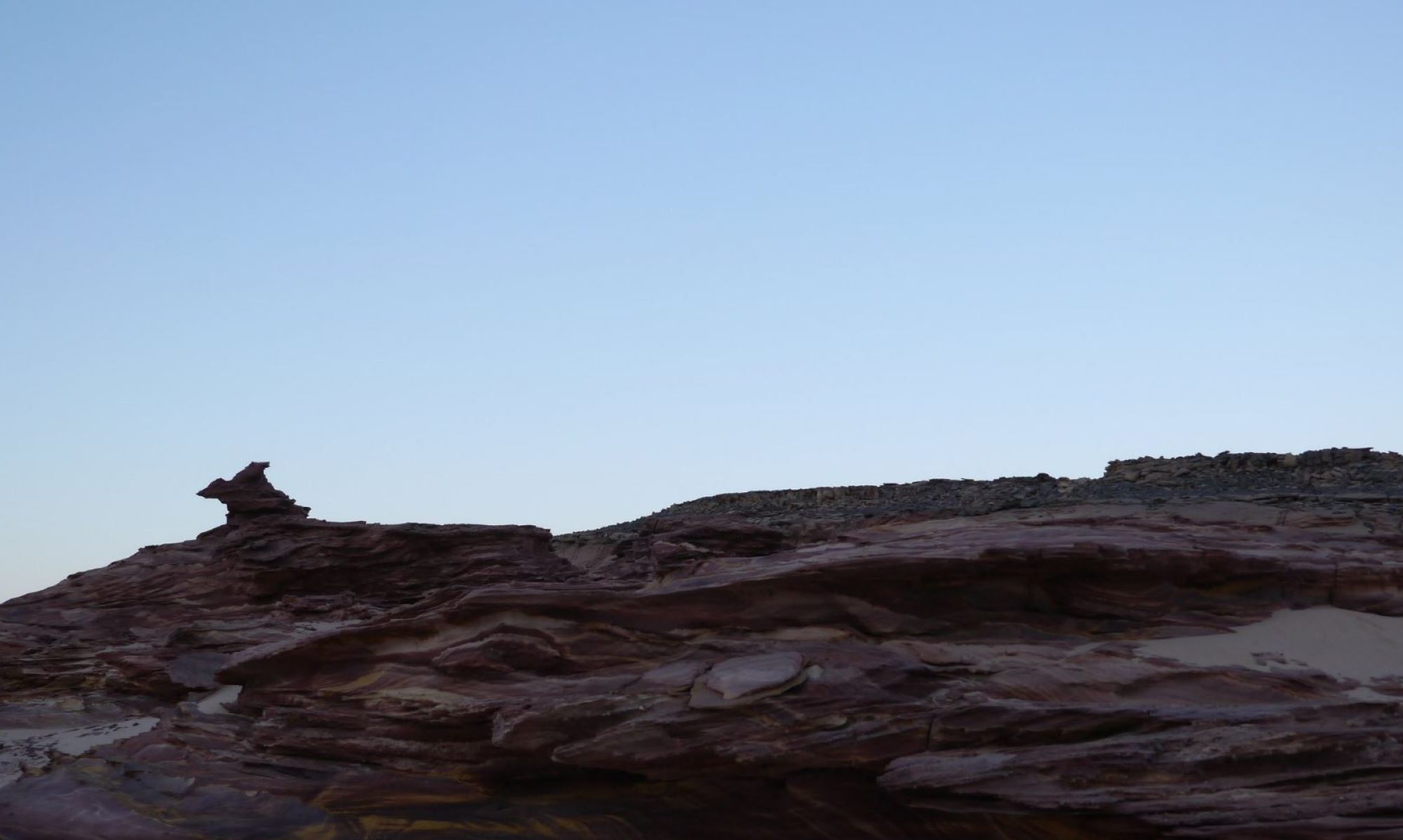
No more so than the afternoon we headed for the rock at the most northern tip of the archipelago. Rossøya barely broke the waters. It was a bony mound, far less ornate than the ones I’d made and inhabited with shells, string and beads. There was no sign of the driftwood and washed-up plastics we’d found on other beaches earlier in the trip. This piece of land swelled white where snow lay unmelted, black in crevices threading across it, and green at its slimy rim. Ancient continental crust three billion years old, once part of the earth’s mantle, had been pressed upwards by magma, to thicken and aerate on meeting the sky.

The sea was not white but grey. There was still the threat of unseen ice so we inched towards the rock. I was used to living on the water, the roil of a boat, sleeping in motion, being surrounded by the slap and cut of ocean for weeks at time, sometimes only seeing the curvature of the earth as horizon for days. Lucky as I was to have sailed as crew and skipper at various times throughout my adult life, here I toddled on deck. This land was unlike anything I’d witnessed before. Bundled in layers of fleece and thermals, legs outspread, keeping myself upright in the boat’s movement, I was dubious about getting too close to this low arc of rock.

I couldn’t articulate what made me uneasy. It was as if I could feel the act of seeing in my whole body, not just a cognisant recognition of rock. I was turned inside out, feeling the rock skimming below the skin of my throat or stomach. It was similar to what happens when I’m concentrating, making or writing something, trying to articulate how I find the world. Except I wasn’t making anything, just watching this low lying rock be washed by water that both connected and separated us. It was as if I was finding this remote place was within me, too, as if I was recovering an ancient memory for the first time. It felt both true and awkward simultaneously. In my pocket was a piece of fossilised coral from when Svalbard was 50° farther south. Past and present, distance and proximity, mashed together, pulverising any rationale in the grip of wide-eyed wonder. I was fifty-one years old and had never felt such a child.
Worlds in Progress Retreat

Worlds in Progress

A four day/ five night Creative Retreat
facilitated by Sarah Hymas & Katherine Zeserson

Monday 4th – Saturday 9th January 2026
At Woodlands House, Giggleswick. North Yorkshire, BD24 0AX

For those who work and play with words – writers, singers, songwriters, zine or artist book makers, embroiderers, vocal artists, performers, and – and – with a work in progress, who would benefit from time out of the usual routine, to spend time alone and with others on a similar path. (see this for reasons why being around people can be a Good Thing)

This space will support the building of the worlds in our work; future worlds through our work; and a temporary world over the week.

A beautiful balance of together time, cooking, preparing and clearing up together and the normality and extraordinariness of that, snippets of stories, progress, insecurities presenting and being allowed space, gratitude shared with strangers, moments of exhilaration as ideas bubbled and boiled to the surface, care, love, connection. 

This is not a taught course. It is a holding space for exploration, sharing and connection. It is a place to be safe to concentrate on, and expand our faith in, our work, individually and collectively. It’s a time to stop, reflect on your practice, gather yourself, recharge and regenerate.

This is an invitation to be generous with your creative spirit, to invest in the transformative power of giving out and seeing how it comes back differently and enriches you in the process. Bring a willingness to learn, to not know and be open.

Each day includes time solo and together, plus shared veggie/ vegan meals (evening meals will be on a cooking rota). 

There will be plenty of time for you to spend with your own work, be inspired by the quiet and space, as well as be stimulated by the conversations and the internal and external worlds around you.

Optional facilitated activities include creative explorations, play, guided meditation, walks, and singing. 

We invite you to make this an alcohol-free week

An opportunity to be in community with others from different creative backgrounds (whom I wouldn’t normally meet or come across in my everyday life) and the chance to share  talents, experiences and ideas. A chance to focus on my writing without disturbance or distraction. 


Venue
Everyone will have a room of their own. Some with en suite. 
There are two accessible rooms on the ground floor.
Nearest train stations: Giggleswick or Settle. 
There’s room for parking

Arrival: 1700 Monday 4th January 
Departure: 1130 Saturday 9th January 

Cost 
£600, inclusive of all food, accommodation and activities
There are 10 participant places. We can offer a limited number of discounted places. Please get in touch if you’d like to discuss a bursary.
If you are able to pay more, to cover the cost of more bursaries, let us know.

Who we are
Sarah Hymas, writer, maker, facilitator and collaborator, has been running The Writer’s Imaginarium and other creative workshops and retreats for over thirty years. Through all her work she seeks to strengthen the connections between us, and unearth the joy in sharing collective creative spaces.

Katherine Zeserson is a singer, writer, coach and facilitator. She works with individuals, groups and organisations to build clarity and insight, driven by a passionate belief in the essential role of creative and reflective practices for making a kinder, fairer world. 


How to Express Your Interest in Coming Along
email by 1st June: katherine [at] zeserson.com & sehymas [at] gmail.com 
with the subject: Worlds in Progress Residency 
Include, briefly (in the body of the email):

  • Why you’d like to join us for the week
  • What roughly you might be working on (we appreciate things change)
  • Anything you’d like to offer the group during the week, either of your practice or some joyful activity that supports your practice. (This is optional, and can be spontaneous if you are so moved during the week)
  • If you absolutely need a desk in your room.
  • Any dietary requirements or allergies you have. 
  • Other specific needs you’d like us to know about.
  • Whether you’re able to pay £600 standard, need a bursary, or can pay more towards the cost of another bursary

We’ll need 50% deposit to confirm your place as early as possible.  
And the balance to be paid by the middle of October.

Cancellation policy: We can only return your payment  if someone else is able to take your place

Extra Details

  • Couples are welcome to share a room. Both would be still required to pay full price
  • Given that we’ll be working in close proximity we ask that your practice is considerate to others.
  • There is wi-fi at the house
  • Do email with any Qs
It gave me lots of moments of joy, a space to work, a space to play with all the other fab retreatants, space to be on my own, space to be in the beauty of the place, and shared laughter.

Walk with Us

From August 2020 – July 2022 I’ve been part of a team of creative practitioners (Maya Chowdhry and Alex Peckham) making an augmented reality walk in partnership with the National Oceanography Centre for the seafronts of Dawlish (pictured) and Penzance.

The walk incorporates data from a new NOC ‘wirewall’ and existing local monitoring sites on wave height and speed, water levels, tides, beach movement, wind and other weather info into a fictional narrative.

Stopping points along the seafront (and beach, tide permitting) offer people time and visuals to re-view the sea, beach and seawall. Through spoken word and videos the story explores coastal erosion, climate change and the oceanic ecology, asking what is coastal resilience, change and adaptation. In July 2022 we’ll be launching two immersive walks that illuminate the work of the NOC, and past and future changes in the coastal environments along the sea fronts of Penzance and Dawlish,

In Penzance Six Lessons in Walking a Tightrope leads you from from Newlyn Art Gallery to the Jubilee Pool. Using audio, augmented realities and weather and ocean data, it balances the line between celebrating our world as it is now and accepting its changes.

Dive in Dawlish takes you from the railway station along the seawall to Coryton Cove on a magical underwater walk.  Blending science fiction with immersive visuals, you will descend into the ocean while never actually getting your feet wet. Exploring themes of coastal erosion and climate change, ‘Walk With Us’ is for everybody interested in the sea, what lives in it, and how it affects us.

An armchair version of Dive can be watched here

An armchair version of Six Lessons can be watched here

More info here  and here 


Publications

the hispering (Black Sunflowers, 2021) dissembles and reassembles how the world speaks to us and what happens if we listen. It contains meadows, oceans, fairytales and the whisper of unseen creatures. A sequence of prose-poem-like glimpses slip between dream, waking and storytelling; plant and human ecologies; the pervasiveness of water; and how being-birthed and birthing are seeded in every word writeen and read.
Written in the intensity of the April 2020 lockdown in England, it feels as strange as those times, perhaps more hopeful. Read more about its creation on EchoSoundings, or a review of it by Carla Scarano on the Friday Poem. If you’re really curious, you can buy a copy her direct from Black Sunflowers

Cover painting: Winter Sea III by Joan Eardley

melt is an oceanic song of love, of hope, of belonging and longing. It begins in the north west of England, on the shores of Morecambe Bay, and ends in a future that may or may not have been foreseen in the Arctic.

Interspersed with images, tickertape on plastic updates, prose, poems and fragments, the book is an assemblage of joy and despair, of bodies, human and morethan. More ripples surrounding the book can be felt here

£12 (+p&p)  Buy from me and  I’ll slip a little origami wahle in the pages

Postage options


Or buy direct from Waterloo Press

Shortlisted for the Ledbury Munthe Poetry Prize for Second Collections. Judges Sandeep Parmar and Naomi Shihab Nye called it ‘[a]
triumph of imagery interweave, human and sea, these moving poems employ lush, melodious language, rhythmic pacing, a hypnotic sense of attentive presence. Who are we after all, as we acknowledge the push and pull of waves, the mysteries present within every body of water? ‘

Blurbs

melt is a book that demands our attention, slipping as it does, curiously and carefully, between enfolded worlds of intellect and feeling, giving us unique access to an archaeology of perception. As Hymas brings pressure to dailyness and the ordinary, she reminds us of the importance of locating ourselves in an increasingly precarious environment. This is a wise book that asks us to read slowly; a must read for these uncertain times.   Deryn Rees-Jones

In poems of precise observation and restless energy, Hymas shows us world and self as intertidal zones of flux and exchange, ‘ebb-dragged / and flood-ripped open’. There is mourning here, in the face of loss and ecological damage; there is questioning, an interrogation of our human ways of being in the world. But there is also hope, and above all a boundless sense of curiosity, yet without any demand for final knowledge: ‘I want to ask /more questions / I cannot answer’. melt is the work of a poet deeply engaged with the world, always open to ‘what will become’.   Helen Tookey

Sarah Hymas does not ignore that which we do not want to have to comprehend about our ocean, but nor does she preach at us. The restrained prose passages situate the work in the local as place of learning; the lyric sea poems explore extending what is possible for the human body within the more-than-human world. melforms part of the necessary and exciting work emerging today from new understandings of the bodies of water that surround the landmasses we inhabit.     Harriet Tarlo

a flotilla of golden plankton, one of which could be yours #everysecondbreath

.

.

.

Host (Waterloo, 2010)

poetry

“The voices, the stories, the detail and the imagery are powerful, superbly-crafted and original.” Bernardine Evaristo

“The poetry is earthy and takes a no-nonsense approach to setting out their journey from community-based god-fearing and pious, through to the complexity, toughness and verging on faithlessness, of modernity.” Anne Stewart in Artemis

“… excellent at capturing social and religious codes of behaviour, with the acuity of Austen or Alice Munro … Host is a tactile and muscular collection, rooted in the complexities and textures of the physical world. Hymas has created fresh and exuberant work that, at its best, captures the awe of being alive.” Sarah Westcott

Waterloo Press have a few copies left… I think

If you live locally to me and would rather not pay postage costs please get in touch, I’m sure we can arrange something